Purposeful Primitive
Bench Press
The key to upper body power is mastering the bench press and all its variants. A properly performed bench press will dig deep muscular inroads in upper and lower pectorals, front and side deltoids, triceps and even the lats. Our mentors had a very distinctive bench press technique that is sophisticated and nuanced. The bench press done with barbells or dumbbells has a nearly infinite number of variations and possibilities. One surefire way in which to obtain maximal results for minimal time investment is to immerse yourself in the bench press possibilities.
The main characteristics of the signature technical archetypes depend on which of the five sequential variations below are selected. Generally speaking, varying grip widths offer varying physiological effects. Our approach puts a finer point on what grip widths do; when to use them; and how frequently to rotate them.
Bench Ideal
Regardless the bench press variation selected, there are specific technical parameters that maximize muscular inroads and effectiveness. Our system of bench press has five sequential variations. Each variant is designed to target muscles with great specificity. Our bench pressing uses two tools: dumbbells and a barbell. Part of our strategy is to generate contrast when stagnation inevitably appears. Become adept and expert in your use of barbells, with the various grip widths, and dumbbells, that force each limb to carry its fair share. Master the tools and the respective techniques.
Key Technical Points
Incline Bench Push Up
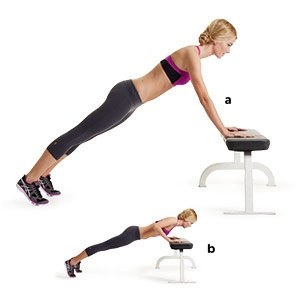
Some beginners cannot do a single bench press with the lightest dumbbells. Find a sturdy support and learn how to do an incline push up. You can start with a railing about 3-4 feet off the ground and then graduate to a bench which is about 2 feet off the ground. Stand three feet away, extend the arms and brace the body against the support. Utilize the upright/planked posture established when learning to squat. Lower to the support with the elbows close to the sides. Then push back up while keeping the body from the shoulders all the way down to the hips tight. This gives a good foundation for the next lift in the sequence - dumbbell bench press.
Dumbbell Bench Press

Dumbbell bench pressing forces each arm to carry its fair share. Sit upright on the edge of an exercise bench with feet planted solidly. Pull two dumbbells close to the torso and lay back. Push the bells up overhead once the body is stabilized on the bench. Lower the bells with tension, pull the bells down; do not lower on limp arms. Inhale while lowering the bells to a position where the hands are slightly below the chest. Push the bells on an arc engaging the feet for the drive. Exhale on the ascent with the dumbbells ending over the top of the eyes.
Barbell Bench Press
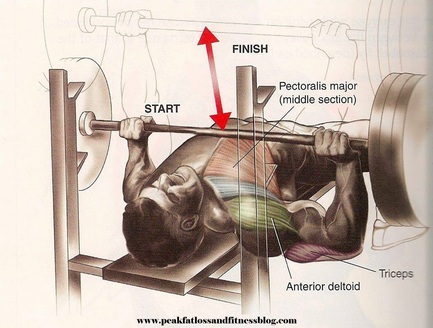
The barbell bench press should be done in the safety of a rack. Lie back on a bench & take a slightly wider than shoulder width grip. This is your neutral/normal grip. Exhale simultaneously pushing upward to break the bar from the support. Inhale and lower the bar down to the high point of the inhaled chest. Do not allow the elbows to flare out, tuck them inward as you lower the bar. Pause the poundage on the chest before firing the weight to lockout. Push upward in a precise arc: bar starts and ends over the eyes. Do not bounce the barbell off the chest to create momentum. Standard or neutral grip width is used for 60% of bench press training time.
Barbell Bench Press Wide Grip
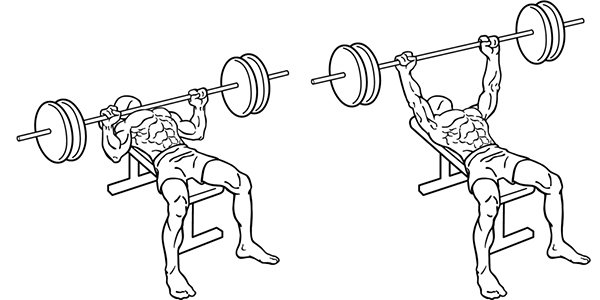
Paused, wide-grip bench presses are the greatest pec builder and strengthener on the planet. The wide grip bench press uses pectoral muscles to near exclusion. It has a hard start and an easy finish. Maximal stress occurs during the first 10 inches of the concentric phase. How wide is wide? The general rule of thumb is to widen your barbell bench press grip by one fist-width. This exercise is usually done with a pause; this makes the hard start even harder. Pushing up and back helps triceps through the sticking point. The elite wide grip benchers will push up and back, in a gradual arc.
Barbell Bench Press Close Grip
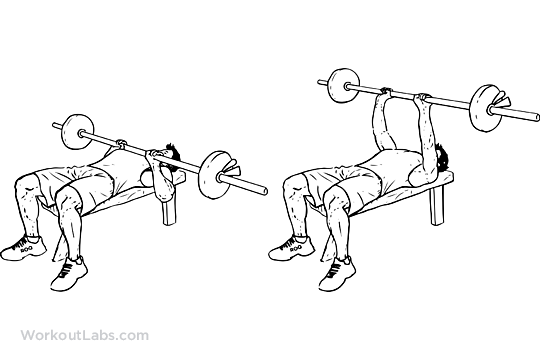
The close grip bench press requires pectorals, triceps and front deltoids work together to compete the rep. Of those three muscles, the triceps are the weakest, and ergo, the triceps are stressed maximally. The narrow grip bench press has an easy start and hard finish. Every rep needs to touch the high point on the chest and requires a “hard” lockout ending with extreme triceps flexion. The narrow grip bench press flies off the chest and stalls when it approaches lockout. While concentrating on wide grip benches builds incredible bench press “start” power, the tricep-intensive narrow grip bench press builds finish power.
MARTY GALLAGHER // Purposeful Primitive Author
We want to hear from you!
Tell us about your training experiences and feel free to forward any training questions to us by clicking on the button below.